
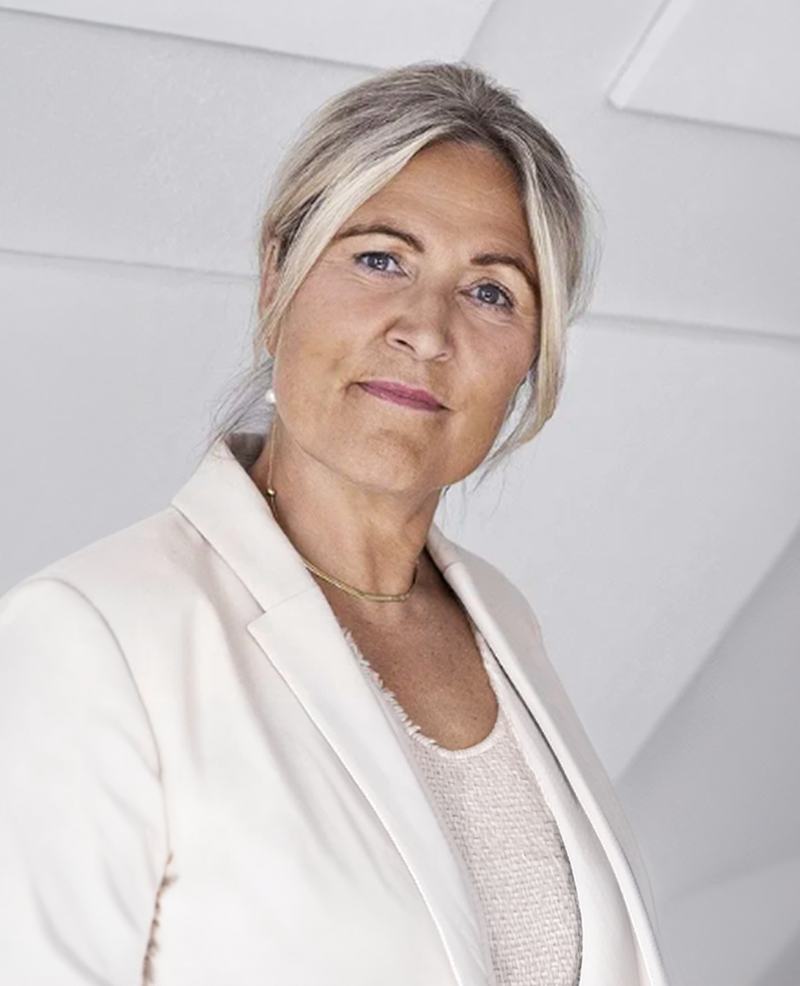
CTO, Early Discovery and Platform Technologies
Orbis Medecine, Denmark
Lena Tagmose is Chief Technology Officer for Early Discovery and Platform Technologies at Orbis Medicines in Copenhagen, a company built to make macrocycles that can be taken as a pill. She is a computational medicinal chemist by training and a builder of discovery platforms by vocation, and her career has circled a question this symposium keeps returning to: what has to be automated, modeled or measured before a difficult modality becomes a routine one.
Orbis is developing nCycles, synthetic macrocycles assembled from a palette of more than 6,000 building blocks, most of them outside the twenty proteinogenic amino acids, and made by routes closer to small molecule API production than to biologics manufacture. The discovery engine, nGen, couples generative design to automated high-throughput synthesis and screening so that each feeds the other from the company's own data. Tagmose oversees that engine end to end, across platform chemistry, screening biology, computational chemistry and data science. In September 2026 Orbis announced a multi-target partnership with Novo Nordisk worth up to USD 1.4 billion, directed at orally bioavailable macrocycles for cardiometabolic targets, together with an equity investment.
She holds a Cand.Polyt. in chemistry from the Technical University of Denmark and a doctorate in computational chemistry, completed in 2000 at the School of Pharmaceutical Sciences of the University of Copenhagen. Her early publications, with Tommy Liljefors, Bente Frolund and Povl Krogsgaard-Larsen, treated agonist and antagonist recognition at GABAA receptors by high-level calculation and by ligand design, and included a series of 3-isoxazolol antagonists. She entered industry at AstraZeneca in 2000 as a computational chemist.
From 2002 she spent more than two decades at Lundbeck. She moved from the bench to leadership of computational chemistry and structural biology in 2007, and by her final years there was senior director for molecular discovery and enabling technologies, responsible for computational chemistry and structural biology, molecular pharmacology and screening, hit identification and early medicinal chemistry, and research informatics. She describes the areas she led as having contributed to more than twenty-two candidate drugs, two of which she delivered herself as project leader. From 2009 to 2015 she led the small molecule BACE1 inhibitor program from inception to candidate selection, and she is a named inventor on Lundbeck patents covering both that chemical series and a family of anti-phospho-tau antibodies.
The through-line is the adoption of new technology before it is comfortable. She drove the integration of fragment-based and structure-based design at Lundbeck from the ground up, including the computational infrastructure and the change management it required, and was an early adopter of cryo-electron microscopy for membrane targets, work that surfaces in the 2022 structures of the human Kv3.1 channel. She brought in medium-throughput patch clamp, GPCR profiling panels and laboratory automation, and hired data scientists into a chemistry organization before that was standard practice. From 2013 to 2018 she represented Lundbeck in the Innovative Medicines Initiative European Lead Factory as a work package co-lead, adding 400,000 compounds to a shared European screening collection. She also set up some of the earliest industrial collaborations applying machine learning to hit finding and lead optimization.
From 2023 to 2025 she was Executive Director and Head of Global External Innovation and Drug Discovery at Angelini Pharma in Rome. She joined Orbis in March 2025 as Executive Vice President for Early Discovery and Platform Technologies and became Chief Technology Officer in March 2026.
Her published record is in small molecule chemistry rather than peptides, and that is part of the interest. The methods she has spent twenty-five years installing, structure-based design, high-throughput screening, laboratory automation and machine learning, are precisely the ones now being turned on macrocyclic peptides, and Orbis is recruiting peptide chemists to run them. She comes to the 30th American Peptide Symposium with a practical account of what it takes to industrialize a modality.