
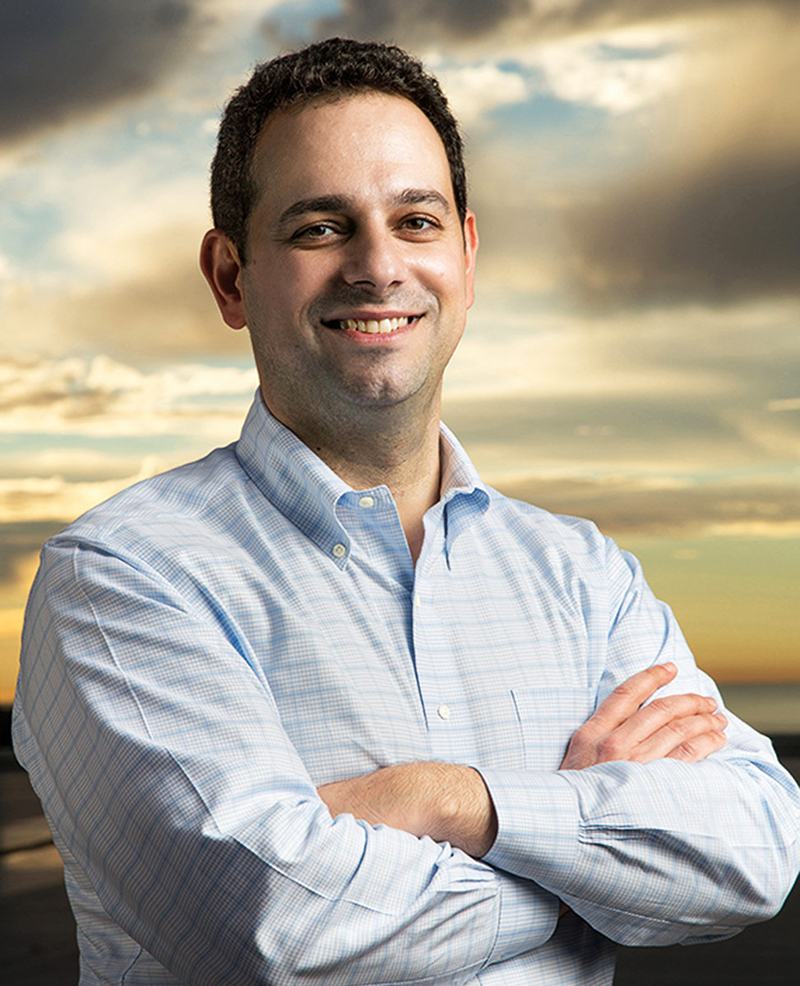
Professor and Dr Frederik Paulsen Chair, Clayton Foundation Laboratories for Peptide Biology
Clayton Foundation Laboratories for Peptide Biology, The Salk Institute for Biological Studies, United States
Alan Saghatelian is Professor at the Salk Institute for Biological Studies, where he holds the Dr. Frederik Paulsen Chair in the Clayton Foundation Laboratories for Peptide Biology. His laboratory looks for molecules that were always present in human biology but absent from our catalogs, and it has found them twice, in two different chemical classes. The first was a family of lipids nobody knew existed. The second was an entire population of human gene products that standard genome annotation had been discarding by rule.
There is a particular fitness to where this work is being done. The Clayton Foundation Laboratories for Peptide Biology is the Salk laboratory in which Roger Guillemin isolated the hypothalamic releasing factors, work recognized with the 1977 Nobel Prize, and in which Jean Rivier spent a career on corticotropin-releasing factor and its analogs. Reaching a few milligrams of thyrotropin-releasing hormone took Guillemin's group hundreds of thousands of animal hypothalami. Saghatelian asks the same question those laboratories asked, which peptides is the body making that we have not yet found, and answers it with mass spectrometry and ribosome profiling. The question is continuous. The instrument is not.
He took a bachelor's degree in chemistry at UCLA and a doctorate at Scripps Research with M. Reza Ghadiri, where his thesis work was as purely peptide as chemistry gets. As a graduate student he was first author on a 2001 Nature paper describing a 32-residue peptide that amplifies homochiral products from a racemic mixture of fragments through an autocatalytic cycle, with an unexpected stereochemical editing function, bearing on how molecular homochirality might have arisen before life. He then joined Benjamin Cravatt's laboratory as a Merck Postdoctoral Fellow, where he learned the metabolomics and activity-based profiling that would define his independent work. He ran his own laboratory at Harvard in the Department of Chemistry and Chemical Biology before moving to Salk in 2014.
The lipid discovery came first. Working with Barbara Kahn on mice engineered to be unusually insulin-sensitive, his group found a class of endogenous lipids that had escaped detection entirely, branched fatty acid esters of hydroxy fatty acids, now called FAHFAs. They are elevated in insulin-sensitive animals, reduced in insulin-resistant humans, and administering them to mice improves glucose tolerance and reduces inflammation. The 2014 Cell paper opened a metabolite class that laboratories are still working through.
The second discovery is the one that should interest this society most. Genome annotation has long applied a pragmatic floor, treating open reading frames below roughly 100 codons as noise, because most such sequences occur by chance. The convention was reasonable and it was also systematically discarding real genes. Saghatelian's group built peptidomics methods capable of detecting the products of short open reading frames directly, publishing the founding survey in Nature Chemical Biology in 2013, and what emerged was a substantial hidden proteome of microproteins, most under 100 residues, many of them functional. One binds the Ku70/80 complex and participates in DNA double-strand break repair. Another, SPAR, is encoded by a transcript long classified as a non-coding RNA, interacts with mTORC1, and regulates skeletal muscle regeneration, reported in Nature in 2017. He has since co-founded Velia Therapeutics to pursue microproteins as a drug discovery space.
For peptide scientists the implication is direct and slightly vertiginous. Molecules of exactly the size this society has always studied were being filtered out of the genome by an annotation threshold, and the tools for finding them are ours. Saghatelian's honors include an NIH New Innovator Award in 2007, a Sloan Research Fellowship in 2011, election as a Fellow of the American Association for the Advancement of Science in 2020, and a Mark Foundation for Cancer Research Endeavor Award in 2022.
He comes to the 30th American Peptide Symposium from the laboratory where modern peptide biology began, with an argument that a great deal of it remains undiscovered.