
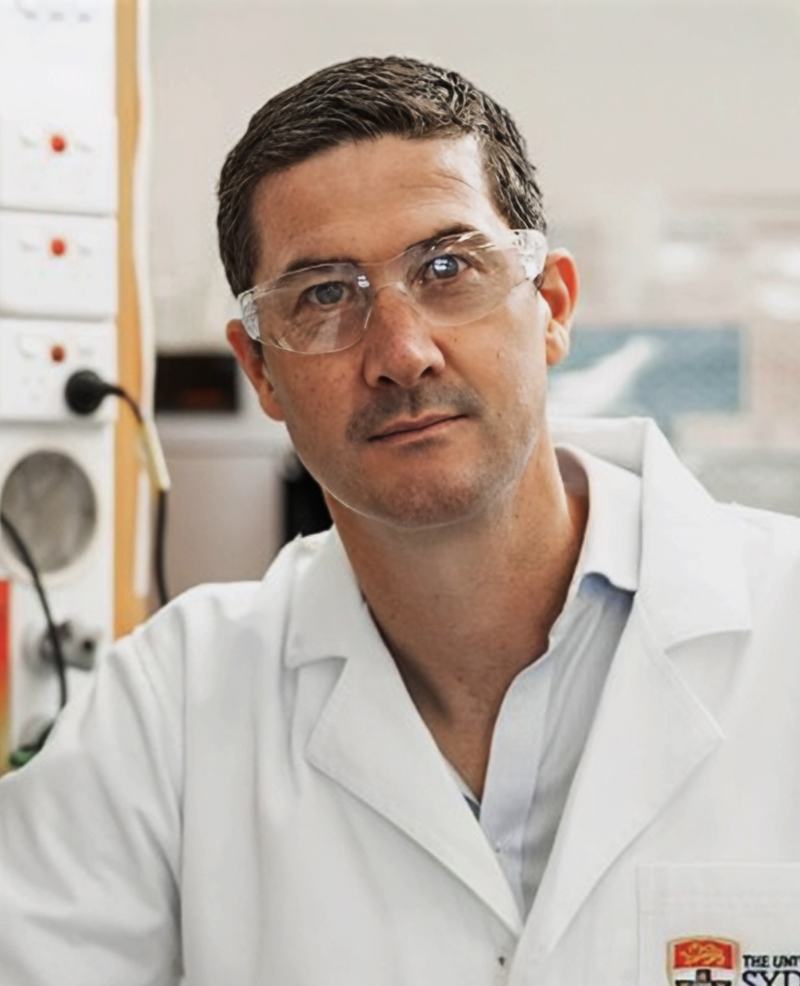
Professor of Organic Chemistry and Chemical Biology; ARC Australian Laureate Fellow
The University of Sydney, Australia
Richard Payne works where synthetic organic chemistry meets biology and medicine, and much of his reputation rests on a stubbornly practical problem in protein synthesis: how to join two large, unprotected peptide fragments quickly and cleanly, and then install the modifications that cells use to control what a protein does. His answer has been to put selenium to work.
With his group he developed diselenide–selenoester ligation, and later an additive-free selenocystine–selenoester variant, reactions that stitch peptide fragments together in minutes rather than hours and that pair with in-situ deselenization to leave a native sequence behind. The chemistry has opened access to proteins carrying glycosylation, sulfation, phosphorylation, and lipidation at defined positions, the modifications that recombinant expression installs heterogeneously if at all. His current Laureate program sets out to automate that assembly on a scale that would let the modified proteome be studied in earnest rather than one construct at a time.
One line of work began with an unlikely source. Blood-feeding ticks secrete proteins that keep a host's blood from clotting, and many carry sulfated tyrosine residues that expression systems cannot place cleanly. Payne's group prepared homogeneous, site-specifically sulfated versions of tick thrombin inhibitors such as madanin and chimadanin, and showed that those sulfotyrosines account for a thousandfold gain in potency, binding thrombin in a mode not seen before – a lead worth pursuing for antithrombotic therapy.
A parallel program takes aim at infectious disease through peptide natural products. The group has completed total syntheses of the macrocyclic peptides that target the ClpC1 protease of Mycobacterium tuberculosis – the ecumicins, ilamycins, and cyclomarins – and used them to work out how each throws the pathogen's protein-quality-control machinery out of balance, work reported in early 2026 with Sydney collaborators. Related efforts pursue leads for malaria and drug-resistant bacteria, alongside self-adjuvanting synthetic vaccines and macrocyclic peptide drug candidates discovered by mRNA display.
Payne completed a BSc with first-class honors at the University of Canterbury in New Zealand and a PhD at the University of Cambridge as a Gates Scholar with the late Chris Abell, working on inhibitors of the shikimate pathway. As a Lindemann Fellow at the Scripps Research Institute with Chi-Huey Wong he took up glycopeptide and glycoprotein synthesis, then joined the University of Sydney in 2008, where he has been Professor of Organic Chemistry and Chemical Biology since 2015.
His work has drawn more than twenty awards, among them the Prime Minister's Malcolm McIntosh Prize for Physical Scientist of the Year in 2016 and the inaugural Tregear Award of the Australian Peptide Association in 2013, and he was elected a Fellow of the Australian Academy of Science in 2023. In 2025 he was awarded an ARC Australian Laureate Fellowship, and that December he was named founding Director of the ARC Centre of Excellence for Advanced Peptide and Protein Engineering, a national center linking Sydney with partners around the world.
He comes to Boston as one of the field's most inventive synthetic chemists, with a career-long case that the fastest way to understand a modified protein is to build it, selenium included.