
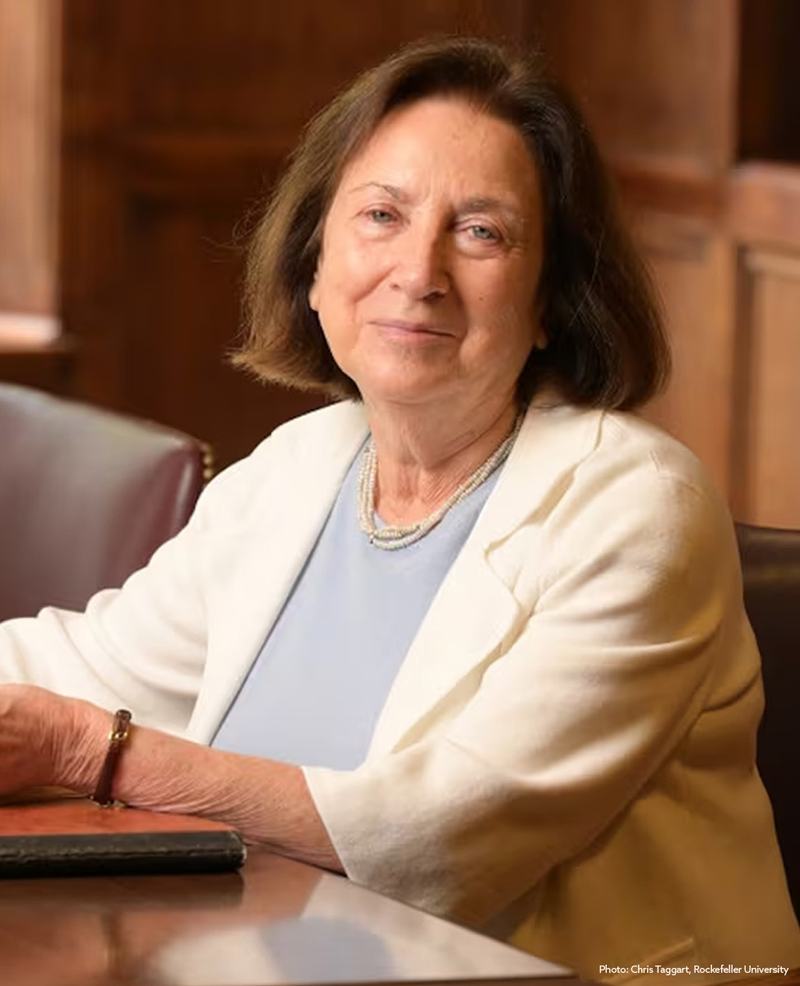
Lulu Chow Wang and Robin Chemers Neustein Research Professor
The Rockefeller University, United States
Svetlana Mojsov is the Lulu Chow Wang and Robin Chemers Neustein Research Professor at The Rockefeller University. A peptide chemist by training, she identified the biologically active form of glucagon-like peptide-1, GLP-1, and showed that it is the long-sought incretin, the gut hormone released after a meal that signals the pancreas to secrete insulin. That discovery is the foundation on which today's GLP-1 medicines for type 2 diabetes and obesity are built, and it began at the bench with solid-phase peptide synthesis.
Born in Skopje in 1947, she earned a degree in physical chemistry from the University of Belgrade in 1971 and came to Rockefeller the following year to join the laboratory of R. Bruce Merrifield, who would receive the 1984 Nobel Prize in Chemistry for the solid-phase method. Her doctoral project was the synthesis of glucagon, with the aim of making analogs that could block its action. After completing her doctorate in 1978 she stayed in the Merrifield group as a postdoctoral associate and later research associate, developing efficient solid-phase routes to glucagon and its analogs.
In 1983 she moved to the Endocrine Unit at Massachusetts General Hospital as Instructor of Medicine at Harvard Medical School and founding director of the Howard Hughes Medical Institute peptide synthesis facility. The timing was decisive. Newly cloned preproglucagon sequences had shown that glucagon is excised from a larger precursor that carries two further glucagon-like peptides, but where that precursor was cut to release GLP-1 was uncertain, and the forms first tested showed little biological activity. Mojsov reasoned from the sequence that processing at a single arginine would yield a shorter, 31-residue peptide, GLP-1 7–37. She synthesized the candidate forms, raised antibodies against them, and in 1986, together with Joel Habener's group, showed that GLP-1 7–37 is produced in the intestine.
The functional proof followed in 1987. Working with Gordon Weir at the Joslin Diabetes Center and with Habener, she showed in the perfused rat pancreas that low concentrations of synthetic GLP-1 7–37 potently stimulate insulin release, establishing GLP-1 as an incretin. With David Nathan she then showed that the peptide stimulates insulin secretion and lowers blood glucose in people with and without type 2 diabetes. She is a co-inventor on the patents that Novo Nordisk licensed, and the path from her peptide to long-acting medicines ran through the work of Lotte Bjerre Knudsen, who opens APS 2027. The two share the 2024 Lasker-DeBakey Clinical Medical Research Award with Habener.
Mojsov returned to Rockefeller in 1990, where she has continued to study peptides that regulate glucose metabolism, among them GLP-1 and the neuropeptide PACAP-38, together with their G protein-coupled receptors. In the 2010s she turned to fish, whose glucose metabolism is controlled by different pathways than in mammals. With Deena Oren she characterized a zebrafish class B receptor with dual selectivity for GLP-1 and glucagon, a property not found in any mammalian receptor and a natural precedent for the dual-agonist strategies now being pursued in peptide therapeutics. Her laboratory continues to study how glucagon and GLP-1 interact with their receptors.
Her recent honors include the 2024 Pearl Meister Greengard Prize, the 2024 BBVA Foundation Frontiers of Knowledge Award in Biology and Biomedicine with Daniel Drucker, Joel Habener and Jens Juul Holst, the 2024 Tang Prize in Biopharmaceutical Science with Joel Habener and Jens Juul Holst, the 2024 Princess of Asturias Award for Technical and Scientific Research with Daniel Drucker, Jeffrey Friedman, Joel Habener and Jens Juul Holst, the 2024 Lasker-DeBakey Clinical Medical Research Award with Joel Habener and Lotte Bjerre Knudsen, and the 2025 Breakthrough Prize in Life Sciences with Daniel Drucker, Joel Habener, Jens Juul Holst and Lotte Bjerre Knudsen. She also received the 2025 Warren Triennial Prize and the 2025 Distinguished Medical Science Award of the National Library of Medicine. She was elected to the National Academy of Sciences in 2025, received the 2026 Kimberly Prize from Northwestern University, and is the 2026 laureate of the King Faisal Prize in Medicine.
Few careers make the case for peptide chemistry as plainly. A peptide made by hand, in the right sequence, answered a physiological question that had been open since the early twentieth century and became the basis of medicines now taken by millions. She speaks in plenary session at the 30th American Peptide Symposium.