
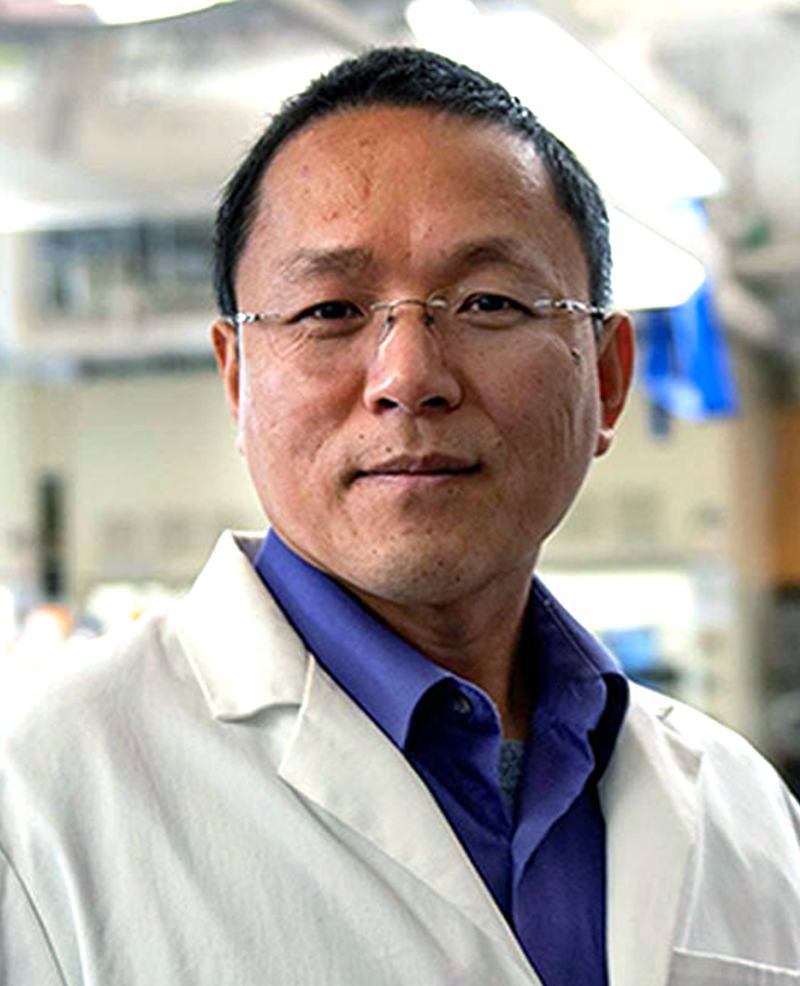
Regents Professor and Harry E. Bovay, Jr. Endowed Chair in Chemistry
Texas A&M University, United States
Wenshe Ray Liu asks what becomes possible when the genetic code is no longer limited to twenty amino acids. The ribosome builds proteins from a fixed alphabet; Liu's laboratory has spent close to two decades expanding it, reassigning codons so that a cell installs chemistry of the chemist's choosing at a precise position in a protein.
The central tool is the pyrrolysyl-tRNA synthetase and its partner tRNA, an orthogonal pair that can be evolved to charge a noncanonical amino acid and deliver it in response to a reassigned stop codon. Close to two hundred noncanonical amino acids have been encoded this way, more than eighty of them developed in Liu's group, and his lab has pushed the method further, engineering synthetases to place two different noncanonical residues in a single protein and ligating expressed proteins without the inteins the technique usually demands.
That capability answers questions elsewhere in biology. By installing defined marks – acylations and methylations of lysine – at single sites on histones, the group can ask how one chromatin modification changes the behavior of the nucleosome, a question that requires homogeneous protein and is otherwise studied with mixtures.
In early 2020 Liu turned the lab's chemistry on SARS-CoV-2. His group was among the first to flag the potential of existing antivirals, then developed its own inhibitors of the viral main protease, including the covalent inhibitor MPI8 and a series of azapeptides, and worked out host factors the virus relies on. The peptide side of that effort is especially relevant here: by expanding phage display to carry noncanonical amino acids, with a purpose-built amber-suppressing helper phage, and cyclizing the displayed peptides, the group discovered a macrocyclic peptide that neutralizes the virus, and has carried the same active-site-directed selection to other drug targets.
Liu studied chemistry at Peking University and earned his PhD at the University of California, Davis, with Michael Toney. He was a postdoctoral fellow at the Scripps Research Institute with Peter Schultz, who pioneered genetic code expansion, and joined Texas A&M University in 2007. He is now Regents Professor and the Harry E. Bovay, Jr. Endowed Chair in Chemistry, with appointments across biochemistry and the medical sciences, and founding Director of the Texas A&M Drug Discovery Center.
His honors include an NSF CAREER Award, selection as a Texas A&M Presidential Impact Fellow, and appointment as a Regents Professor of the Texas A&M University System in 2025. Over the life of the program he has trained more than forty doctoral students and some two dozen postdoctoral researchers.
Wenshe Ray Liu’s lab is featured in the Society’s own Global Peptide Groups series, which walks through the group’s genetic code expansion and peptide-discovery work in more detail.
He comes to Boston with a body of work that has made the expanded genetic code a routine instrument of peptide and protein chemistry, and, when the moment demanded it, a tool turned quickly against a pandemic.