
Professor of Chemistry
New York University, United States
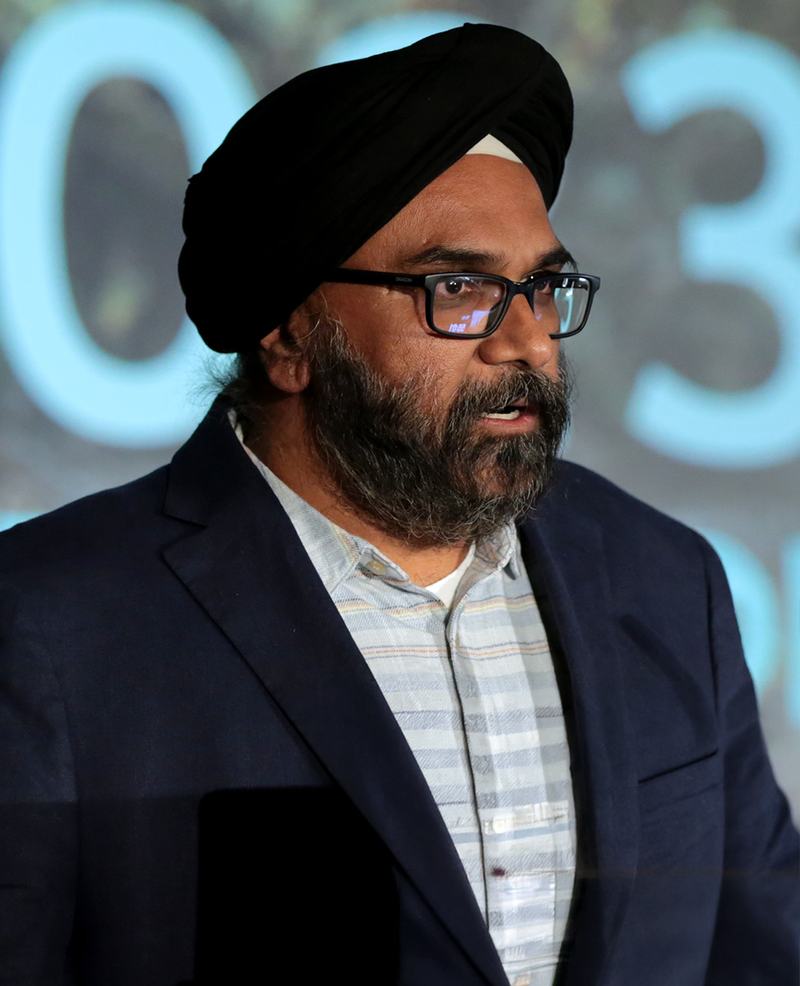
Paramjit “Bobby” Arora is Professor of Chemistry at New York University and one of peptide science’s most persistent advocates for a simple proposition: the folded shapes that proteins use to recognize one another can be reproduced in small, stable synthetic molecules, and doing so opens protein–protein interactions to rational drug design. Large, shallow interfaces once written off as undruggable have been the central target of his laboratory for more than two decades.
His best-known contribution is the hydrogen bond surrogate, HBS, strategy. Rather than bracing a helix from the side, HBS replaces an N-terminal i→i+4 main-chain hydrogen bond with a covalent linkage, nucleating the helix from within while leaving every side chain free for recognition. His group has applied HBS helices to therapeutically significant interactions, including p53–MDM2 and the HIF-1α–coactivator complex, where HIF-1α mimetics reduced tumor burden in mouse xenograft models. In parallel, the lab developed oxopiperazine helix mimetics, nonpeptidic scaffolds that reproduce the side-chain topology of an α-helix, and has carried the same design logic into RNA-targeting peptidomimetics.
A second line of work addresses how peptides are made in the first place. With NSF support, Arora has developed catalytic methods for amide bond formation, aiming to replace the large reagent excesses of conventional solid-phase synthesis with more efficient and greener catalytic cycles.
Arora received his B.S. in chemistry from the University of California, Berkeley, and his Ph.D. from the University of California, Irvine, with James Nowick, followed by postdoctoral work with Peter Dervan at Caltech. He joined the NYU faculty in 2002. The American Peptide Society honored him with the Rao Makineni Lectureship in 2019 for recent contributions of unusual merit, and in 2024 he received the ACS Ralph F. Hirschmann Award in Peptide Chemistry. He has served the Society as President and is now its Immediate Past President. He is also committed to widening access to the field, having co-directed NYU’s NSF Research Experiences for Undergraduates site in chemical biology and developed research-based teaching modules shared with faculty at historically Black colleges and universities and colleges in Puerto Rico.
He comes to the 30th American Peptide Symposium with a long view of what it takes to turn a structural idea into molecules that work in cells and in animals.